
On that Day, Every Knee Shall Bend (1)
The first of a two-part series on AI and history
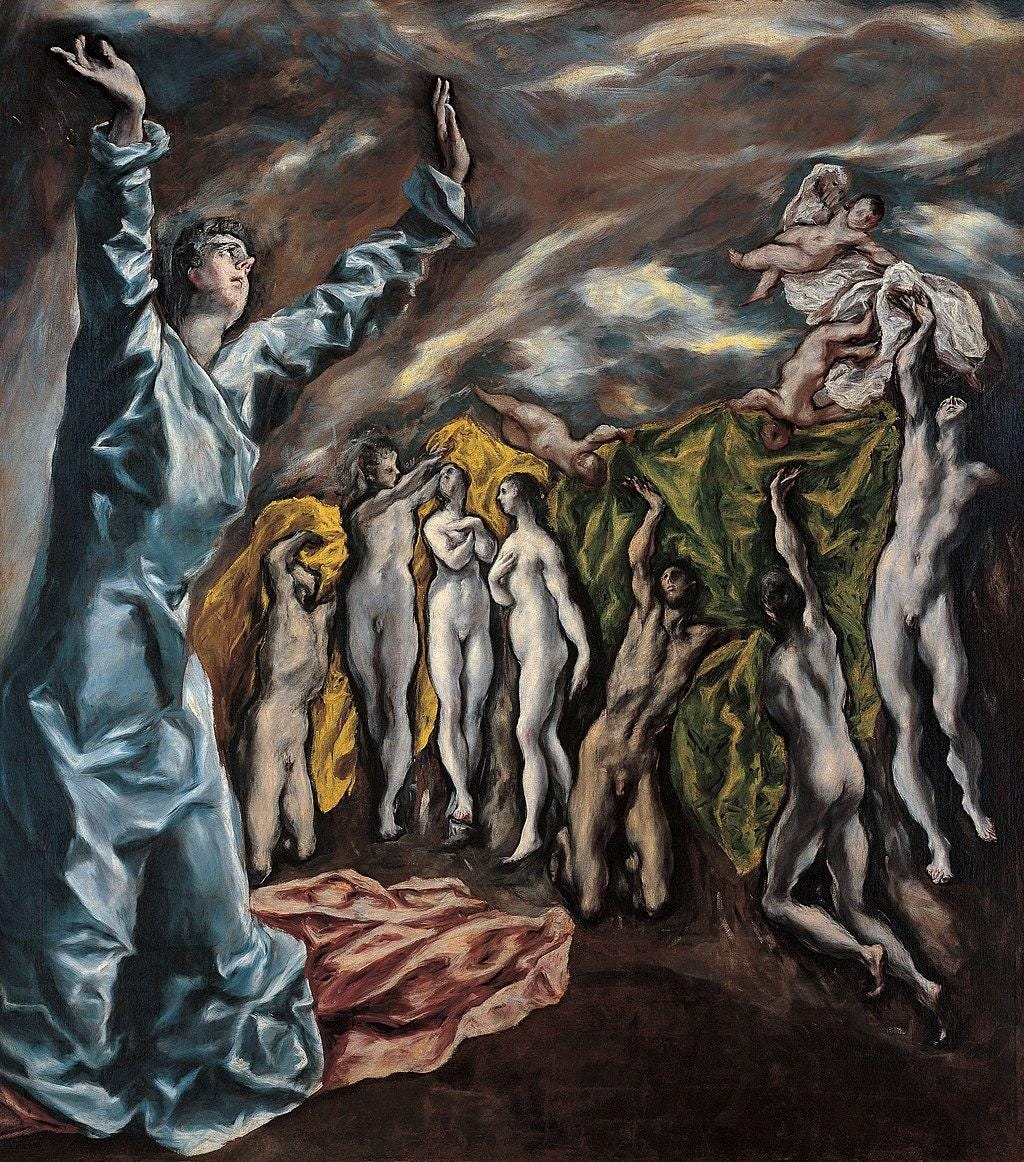
Hillel says: Do not separate yourself from the community.
-Pirkei Avot, 2:4
There has been an enormous amount of writing on so-called AI in the past few months, and while I do not want to contribute to over-saturation of the topic, I do feel that there are one or two angles towards this technology that have not yet received sufficient coverage. Many of the current approaches are focused on the tangible and more-than-relevant question of how these tools are being rapidly adopted (with, it seems, insufficient quality control), and whether they actually deliver what they promise. Hence, we find reports of a transcription service used in hospital settings that hallucinates text out of thin air, or a service that summarizes lectures and notes for college students without the annoying hindrance of internal understanding.1 Understandably, financiers and investors are becoming increasingly curious to see how this world-changing technology is supposed to actually make anyone money. And from the AI companies themselves, we have two recent works which are quite obviously sales pitches to said investors, but present themselves as manifestos to the general public.
My perspective is that there are two additional approaches that have received less attention, but that I feel would be fruitful in understanding a technology that its proponents suggest will vastly alter human society as we know it.
The first issue is to revisit some of the inherent logics which underlie the use of technologies such as the computer and the internet by a mass audience. This is not a technical examination of these technologies, so much as a question about what the typical end-user might experience — and be encouraged to experience — by virtue of their use in the first place. This will require pulling in the theories of Marshall McLuhan and, to a greater extent, Neil Postman.
The second matter is the world-historical (post-historical?) stakes of the claims being made by the proponents of AI tools themselves. Bracketing the cynical approach that AI manifestos are largely advertising techniques by for-profit businesses, there are a number of claims in these manifestos that I believe articulate a vision of history (and borderline soteriology) that have precedent in world-historical and, more interestingly, religious forms.
As such, this will have to be a two-part essay, beginning with a background in the media studies approach to new technologies, and culminating in the next installment addressing the AI manifestos themselves.
Still amusing ourselves after all this time
Many discussions of the effects of technology on the human are framed through the lens of Marshall McLuhan, and rightfully so, but it is likewise true that there is much to be drawn from his inheritors such as Neil Postman. Bracketing their actual arguments for a moment, what is most immediately striking about Postman is a significant difference in the tenor of his work. McLuhan could be pessimistic in his feeling of an “implosion” in Western technological society, but there are likewise statements that are positively oracular. Take this from his 1964 collection of essays, Understanding Media:
Rapidly, we approach the final phase of the extensions of man — the technological simulation of consciousness, when the creative process of knowing will be collectively and corporately extended to the whole of human society, much as we have already extended our senses and our nerves by the various media. (19)
I am aware of the irony of posting this online and contributing to the artificially-constructed collective consciousness, but one has to admit that this is quite prescient. As will become clear, there is a prophetic element in Postman, as well, but it is less “Cumean Sibyl” and more “Jeremiah of the Hebrew Bible.”
I recently read Postman’s Amusing Ourselves to Death, which is an analysis of media and the human that has a palpable underlying thread of concern bordering on despair. I’d like to cover his argument at some length, as I have not seen him often invoked in evaluating more cutting-edge technology (though it may be out in the Internet aether).
To back up: Postman’s starting point is a variation on the most famous phrase of McLuhan, “the medium is the message” — that is, that regardless of the “content” of a piece of media, there is a meta-significance to the manner in which the medium/technology affects the “scale or pace or pattern” of human life (24). McLuhan’s evocative example is the light bulb, which is ostensibly content-less and merely a tool for us to consume other forms of media. But for McLuhan, electric lighting is making a comment about the human relationship with time and space — you can have light for 24 hours a day, every day, without natural constraints — the same way that radio or television collapse time and space to allow near-instant, worldwide communication. These technologies thus have an underlying message about how humans communicate, with whom, and how quickly, beyond whatever “message” is being communicated through them.
Postman’s “amendment” to the theme is that the “medium is the metaphor:” while media do not have a “message,” which is a “specific, concrete statement about the world,” forms of media work like metaphor, through “unobstrusive but powerful implication[s] to enforce their special definitions of reality” (10). In this way, Postman is concerned about the “content” passing through media as well as the internal logics of the media themselves, as these pieces of content are molded into certain forms by the supposedly value-neutral media in which they are transmitted:
My argument is limited to saying that a major new medium changes the structure of discourse: it does so by encouraging certain uses of the intellect, by favoring certain definitions of intelligence and wisdom, and demanding a certain kind of content — in a phrase, by creating new forms of truth-telling. (27)
In other words, Postman wanted to see how the medium might actually mold the message, inherently showing a preference for certain forms of expression and thought-processes. The case studies invoked by Postman would be the transition from a print-based, “typographic mind,” to one in which the primary medium of communication was television. As will quickly become clear, Postman was not a fan of the latter.
For Postman, print lends itself particularly well to “coherent, orderly arrangement of facts and ideas” (51) by virtue of how it compels us to both write and read. Writing is “sequential, propositional” — it forces the writer to articulate ideas in a reasoned manner because the reader will be prepared to critically evaluate the message. Postman is not saying that all writing follows the typographic ideal (“detached, analytical, devoted to logic, abhorring contradiction” (57)), and on the contrary, he noted that the reality that not all writing is trustworthy or accurate means that the reader is forced to evaluate typographic claims carefully. In order to communicate a message in print that will be taken seriously by a broad audience (as the printed word is typically published for the whole world), one is expected to marshal evidence, present an argument in context, defend it from criticisms, and acknowledge alternative schools of thought. Postman was not saying that all forms/genres of writing were intended to meet such standards,2 but that the internal logic of print as a medium lends itself to this form of communication.
In contradistinction to the printed word is placed television and its predecessors, the telegraph and the photograph, which, for Postman, contribute towards fracturing and superseding the typographic mindset. The telegraph is the beginning of freely-flowing information devoid of context, giving credence to “the idea that the value of information need not be tied to any function in social and political decision making…[but] merely to its novelty, interest, and curiosity” (64-5). You might receive a series of telegraphs listing events from across the country — a technological marvel at the time, surely — and feel that you are connected and up-to-date on all American events. But what sort of connection is this, really, if it emerges from no background, tells you something to which you have no real relation, and is just as quickly replaced by the next telegraph? To Postman, the telegraphic mind knows lots of things without knowing about them:
The telegraph may have made the country into ‘one neighborhood,’ but it was a peculiar one, populated by strangers who knew nothing but the most superficial facts about each other.
For the first time, we were sent information which answered no question we had asked and which, in any case, did not permit the right of reply. (67; 69)3
The partner to the telegraph, which removes from context the physical world rather than the typographic, is the photograph, which provides an image “devoid of any relationship to your past knowledge or future plans” but nonetheless seems to have great meaning by virtue of its capturing an image-in-time (73). Postman’s concern is what results from a “‘language’ that denied interconnectedness, proceeded without context, argued the irrelevance of history, explained nothing, and offered fascination in place of complexity and coherence” (77). What remains is entertainment, which for Postman is the meta-language of television par excellence.
While much of the second have of Amusing is devoted to televisual programming that Postman seems to have watched with increasing dread, what is relevant for evaluating media-to-come is the way that these metaphorical metalanguages predetermine the content which flows through them. The argument is not that there are not television programs which are informational, serious, or educational — it is that television takes informational, serious, or educational programming and demands that it become entertaining. This will seem obvious to anyone who has read, say, 90s-era hysterical fiction and its ambivalent relationship with television,4 but Postman’s argument is that as television requires “minimal skills to comprehend” and aims for the “emotional gratification” of the viewer, it “made entertainment itself the natural format for the representation of all experience” (86-7). The paradigmatic example of this for Postman is supposedly-serious news programming, which is oriented around the idea of freely flowing from one story to another, i.e., “now…this:”
The phrase is a means of acknowledging the fact that the world as mapped by the speeded-up electronic media industry has no order or meaning and is not to be taken seriously. There is no murder so brutal, no earthquake so devastating...that it cannot be erased from our minds by a newscaster saying, ‘now...this.’ (99)
The point of sharing so many direct quotations from Postman is not to complete a book report on Amusing Ourselves, but because I think it will be obvious to the reader how many of these concerns can be easily transposed onto concerns over the internet or social media. What is the experience of scrolling X-formerly-Twitter if not joke, meme, sports clip, meme, horrific image of humanitarian suffering in Gaza, sports clip?5
Consider a response to Postman, as it is a response that has endured well into the Computer Age: why not just turn it off? Recall, though, that forms of media in Postman’s view necessarily are an “ideology” in themselves, in that television (or computers, or the Internet) is something that “imposes a way of life, has a set of relations among people,” and that it imposes these strictures with “no consensus, no discussion, and no opposition” (157). As new technologies force themselves into patterns of human life, “how [they] stage the world becomes the model for how the world is to be properly staged” (92). This is why it is foolish, in a Postmanic system, to consider that there is a “real life” outside of television or the Internet; television and the Internet direct “real life” as much as they are directed by it, simply by virtue of their affecting how real-life human society thinks and acts.
Neil Postman, you would have hated it here
On that note. I have seen a few tentative reviews of Postman in relation to the Internet and social media, and these approaches largely take Internet culture as both and extension and intensification of the medium of television. I feel that this is necessary, but insufficient. Of course, while reading the block quotes from Amusing Ourselves above, there is much that can be recognized as relevant for our current informational/technological climate. That said, there are elements of the Internet’s metalanguage that are worth being distinguished from television, as certain elements of them are themselves being refined with so-called “AI” tools.
First, there is the question of what Amusing Ourselves had to say about computers. As the work was written in 1985, it was being put together in what was still the early days of personal computing, and Postman had seen enough to be suitably unimpressed:
Although I believe the computer to be a vastly overrated technology [!], I mention it here because, clearly, Americans have afforded it their customary mindless inattention; which means they will use it as they are told, without a whimper. Thus, a central thesis of computer technology – that the principal difficulty we have in solving problems stems from insufficient data – will go unexplained. (161)6
Postman’s hesitation about this thesis of computation is rooted in a concern about an increase in “information” — which is already a curious thing to set aside as a concept — leading not to efficiency and satisfaction, but to an informational “din,” “glutted with information, drowning in information, have no control over it, don’t know what to do with it.” This is largely in line with his through-line concern of “information” becoming detached from context and significance, falsely viewed as relevant, and failing to provide lasting knowledge about the very subject about which it claims to inform.
What makes Postman continue to be compelling nearly 40 years later is the fact that his central thesis is still useful in understanding the ideology of computers. The implication behind many of the platforms that dominate our daily lives is that, well, yes: our central issue is insufficient data, and problems can be solved by increasingly complex technologies that can summon that data, ideally answering questions before we have even asked them. I believe part of where the Internet diverges from being a simple extension of television in being a medium primarily meant to entertain — though this is certainly a part of it — is that computational and Internet technologies7 have other ideological imperatives. For the sake of space, I would like to note just one of these: the imperative to connect, and the idea of this being an inherent good.
The connections will continue until morale improves
The logic of computational connection is linked to what would likely be a major criticism of connecting computers to Postman’s observations on the telegraph, the photograph, and the television. For the Internet in general, and social media in particular, not only permit the “right to reply,” but largely demand it. To break the fourth wall, as someone who is currently writing a series of long-form essays on an online platform which are going to be read by other Internet users, this is indeed a potential way for Internet users to break from the wholly-passive experience of watching television.
Social media would be the obvious case here, though there are certainly elements of its use that line up wholly with how Postman described the telegraph, the photograph, and television. It is easy to poke fun at any corporate slogan, and the one-line quips of social media companies are both informative of this ideology of connection and delightfully vague. The one that would have most horrified Neil Postman is almost certainly the ominous couplet from X-formerly-Twitter, “Happening Now. Join Today,” with no discussion of what is happening, and why something “happening” means that I should be joining in this Event. Similarly from Facebook, “Connect with what you love to make things happen. It’s Your World,” where one must ask what “things” we are talking about. There is an idea in these catchphrases of both immediate importance and self-direction. This surely feels like a departure from television, where while you can change the channel, it requires network credentials to determine what is actually on those channels. Of course, we know by now that the idea of determining one’s own online world is a bit of a misnomer in the face of algorithms which can place their proverbial fingers on the scale to encourage various emotional responses. But more important here than the reality of the user experience is the idea of an immediate imperative to connect oneself into the broader network, that this is where “Your World” takes place.
Anyone who has spent any number of hours on these sites knows that pairings of words and images which are completely without context and fade meaninglessly from one burst of information to the next is not a bug of these systems so much as their entire point. But, that being said: even though I suspect that the ratio of consumption to participation on social media sites is, for most people, massively weighted towards the former rather than the latter, it is very much possible to reply. If anything, interaction is encouraged, as it theoretically provides the platform with a data point by which its algorithm may continue to send you the kind of conversations you would like to participate in.
In Postmanic analysis, though, one must still wonder about the “relevance” of this content. It is as possible to like photos of your cousin’s child as it is to respond to a politician across the country that you think he is a dyed-in-the-wool moron, and while one of these appears to have inherent personal importance, they are not weighted as such in the social media experience. On the contrary, by being presented one after another on a social media For You page, these pieces of information are necessarily made to appear as equally important, or, to be more cynical, equally ephemeral.8
Into the desert to Azazel
One thing about constant connection, too, is that one is by definition unable to truly be alone. There is no need to re-invent the wheel and discuss how heavily-surveilled the Internet is, whether for governmental purposes, generation of advertisements, or, now, to train AI models. I would suggest, though, that this surveillance is largely inevitable because of the metalanguage of computers in the first place. If problems are solved through acquiring sufficient data, then the collection of data becomes a sort of inherent good. This is part of why there is such an imperative for universal connectivity of not just humans, but of basically anything humans use. Certainly we have all seen people complain as to why their washing machine or refrigerator has to have a wi-fi connection, and there is a hack joke to be made about appliances also suffering from the Fear of Missing Out. But this is perfectly in line with the idea that greater and immediate information delivery can lead to efficiency, satisfaction, the solving of problems, and flows naturally from the internal logics of computers and the Internet themselves.
This, linked with social media, is why you see an uncanny moral imperative behind the use of technology, and a defensiveness when criticisms of it are raised. One element is the idea that by removing oneself from Internet connectivity, one is removing a data point that contributes towards the solving of problems. This means that pulling away from a technology that is fracturing your attention span and manipulating your emotional currents is actually a blow against your fellow travelers in humanity, to whose use your data point may have been put to improve efficiency and reduce friction.9
A second element requires returning to the opening epigraph. While social media is, in part, irresistible because the platforms function as gossip aggregators, it would be unfair to wholly write off their practical uses as a way to maintain relationships, even if only online. Even bracketing the algorithmic imperatives for sensationalism, the exploitation of personal information for advertising, and the aforementioned risk of trivializing the important, there is undoubtedly a core appeal in being able to maintain or revive connections with old friends, hear about updates with family who live far away, or simply find people who are interested in the same books, hobbies, or films as you are — to build community. This is a well-worn point, but I think there is a growing realization that these tools are not separate or supplementary to patterns of human interaction, but fully embedded within them. So, to indulge in one’s Luddite tendencies is to not only spurn a technology company but to turn one’s back on all of the people who are busy making connections on these platforms — to make an exile of oneself from the community where things are Happening.
Much of this may feel familiar, but I feel it is worth laying this groundwork for the second part of this essay, which will consider some of what Postman would have considered technological ideologies behind AI tools, which are being incorporated into a number of human institutions with eerie rapidity. I will primarily discuss two recent pieces of writing that I would consider manifestos of AI, which are laden with their own ideological commitments while promising a glorious (and inevitable!) future of technological utopia.10 Arguments of destiny are theories of history, and I would like to think about the vision of history we are being sold.
Edit: Bibliography
McLuhan, Marshall. Understanding Media: The Extensions of Man. New York: Signet, 1964.
Postman, Neil. Amusing Ourselves to Death: Public Discourse in the Age of Show Business. New York: Penguin, 1985.
I will give the authors credit that their tone seems to communicate that AI tools being rapidly adopted by students, administrators, and a clutch of Vichy professorial collaborators at the risk of destroying college education as we know it is an effect of a number of preexisting weaknesses in the university model, not the cause. The “latent logics and transformations” of viewing the actual academic research and coursework of the university as something between customer service and an expensive inconvenience were, indeed, put in place long ago.
Nor should that be in the expectation — in the case of, say, a novel, there is a different goal altogether than the carefully reasoned intellectual argument. This does not mean for Postman or for us that novels are “poorly reasoned.”
A major question of the Internet, which I will address momentarily, is how the right-to-reply is incorporated into a Postmanic system.
This is by no means a criticism of those who would share such information out of their (rightful) horror, frustration, etc. It is fear of the power of the medium to override such messages with its own logic of frenetic, rapid information sharing, as I will revisit in a later footnote.
Emphasis my own.
Which I am, admittedly, using interchangeably for reasons that will become obvious in a moment, but could be felt to be an elision of two forms. I suppose the question is, was there any other possible outcome than the Internet once computer networks — even rudimentary ones — were developed? It strikes me as a natural outgrowth.
This is, I feel, a limitation to social media’s ability to be a driver of social change at the level of particular issues or crises (it has already been a driver of mass social change at a macro- level in bending human communication and social organization to largely run through its particular format). Social media can be very good at, for example, helping someone who is lonely or isolated find other like-minded individuals, and it would be shortsighted to ignore this as a potential benefit. But a concordant risk, as alluded to above, is that posts of words and images on topics that are deadly serious, such as political crises or humanitarian disasters, are fit into a timeline with equal gravity as posts of pure trivia, and thus trivialized by virtue of the medium through which they are shared.
This article quite funnily discusses how, having realized the risks of frictionless human decision making, tech companies have started introducing a bit more difficulty into instant reaction online.
A related question: are you allowed to see the vision of a utopia of justice and peace and decide that it’s not for you?